A few months ago, Grant David Crawford published an essay called The End of Elsewhere. It entered Substack virality, drawing thousands of reactions and sparking online debate over the 40-minute essay. The gist: the 300-year Western tradition of searching for meaning by leaving home and entering parts of the world seen as “other” has died. And my generation is supposed to be the one at the end of it.
Crawford teaches a course on the ethics and politics of travel. For years, he began with an essay called The Myth of Authentic Travel, which argues against the fantasy that there is some real, untouched Thailand hiding behind the tourist one, waiting for the superior traveler to find it.
His students used to argue: Could you travel ethically? Could you find something authentic? Were backpackers different from tourists? Was volunteering abroad helpful or just colonialism dressed in elephant pants?
Now, Crawford says, the room goes quiet. His students are not less intelligent or less curious. They have simply, in his words, lost interest in the stakes.
From that silence, he builds a history. Rousseau. The Romantics. Gauguin. The Beats. Hippies. Backpackers. Voluntourists. Anthony Bourdain. Generation after generation of Westerners looking outside themselves for something modern life had apparently killed inside them.
The destination changed. The urge did not. Until, apparently, us.
I am 22 years old. And I would like to respectfully raise my hand in Crawford’s classroom. Because I think he is right about one thing: I do not believe in Elsewhere either. But I think he is wrong about another: the search is over.
Globalization, climate change, the legacy of colonialism and the education I have received have beaten the fantasy of Elsewhere out of me.
But that doesn’t mean I don’t want to go searching for something intangible. I just got back from walking the Camino del Norte in Spain for that reason. The funny part of the Camino is that it has never claimed to be undiscovered. It is, quite literally, the beaten path. Spain is not the kind of Elsewhere Crawford is talking about. But I still think I have a point here.
For centuries, pilgrims have walked toward Santiago de Compostela. Imagine Santiago as the heart and the different trails as veins. Some are thick and crowded. Some are smaller, blue and quiet beneath the skin.
My twin sister and I walked part of the Camino del Norte, the less popular and physically harder northern route running along Spain’s coast. We began at an airport, which is admittedly less biblical than walking out our front door with a staff.
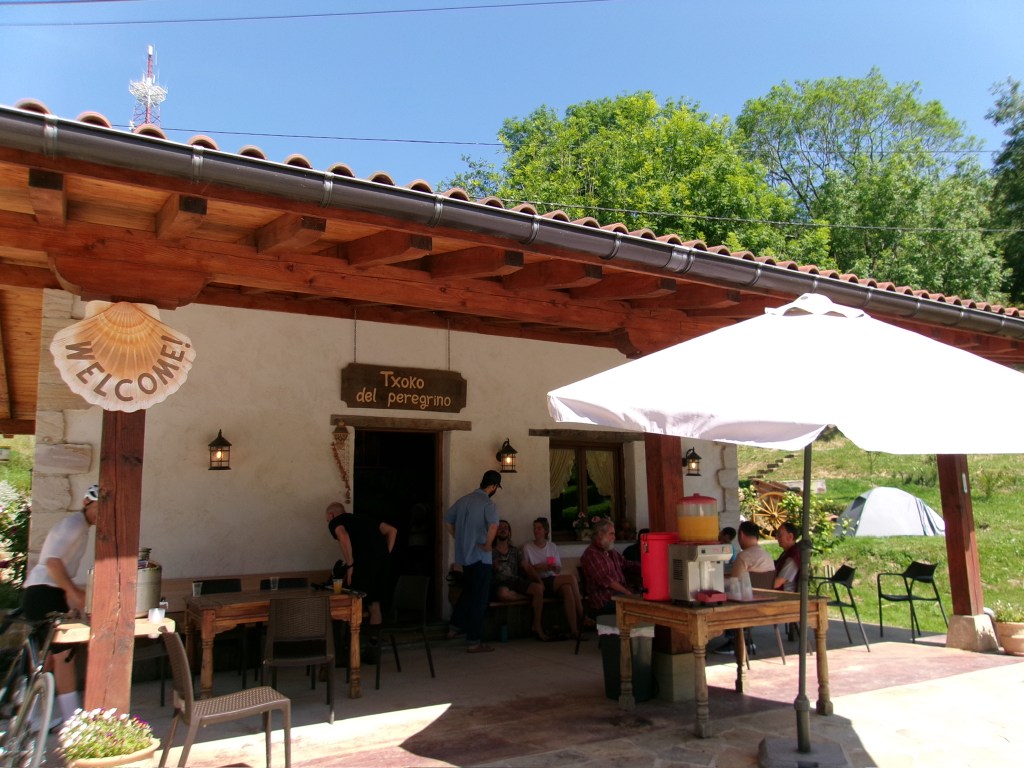
And then we did the thing: followed the yellow arrows telling us where to go. Scallop shells embedded in sidewalks. Pilgrim hostels. Pilgrim menus. Pilgrim passports. Other pilgrims carrying the same backpacks and nursing the same blisters. We smiled and said buen camino to those we passed.
Nobody was under the impression we had stumbled upon an untouched corner of civilization.
Crawford’s argument is that my generation inherited the critique of discovery and the Other before we inherited the fantasy. He is right.
I knew the rich Westerner going abroad to “find herself” was a cliché. I knew voluntourism could hurt the communities it claimed to save and long-haul flights pumped carbon into an already warming planet. I knew an Instagram geotag can turn a hidden gem into tarnished pyrite. I have watched wars and shootings live on my phone, borders harden, walls rise, refugees turned away, forests burn. Beautiful places became content before I could afford a plane ticket to see them in person. I know the person calling something “authentic” is often the person with the privilege to leave when things become uncomfortable or dangerous.
I guess my generation’s innocence is gone.
Well, I am not particularly interested in getting it back. It’s naïveté anyway.
But I think Crawford makes a jump here that I am less convinced by. He sees the death of the fantasy and wonders whether the desire went with it. In my experience, that is untrue.
We no longer need Elsewhere. But we still need movement and friction and perspective.
We need Somewhere.
I walked as a way of reminding myself how inconsequential I am. To get perspective on my life. Up close, a walnut looks like a brain. From far away, a walnut is a walnut. I would say about 99% of the problems in my life are walnuts.
The Camino helped me zoom out.
To do so, my sister and I walked and walked and walked. We got to ogle farmland, eucalyptus forests, fishing villages and turquoise coastlines as we scanned for yellow arrows. Throughout the day, we came upon villages as they appeared, meandering through the places between where we had slept and wherever we hoped to sleep next.
I loved it because instead of picking a destination that you apparate to, you are forced to walk through the connective tissue. All the boring or ugly parts—industrial outskirts and empty roads.
Crawford argues that my generation has already seen everywhere. In truth, I knew what the highlights of the Camino looked like before I arrived. I had seen drone footage of northern Spain and TikTok videos of people explaining the exact number of pairs of underwear they were bringing. The world had been pre-mapped for me.
But that doesn’t mean I should stop going. That’s where I lose him. My generation still wants to get our socks wet, get to the grocery store right after it closes, and order the strange seafood dish the taverna calls its “specialty.”
Spain was never going to reveal Ella Heydenfeldt’s Truest Self beneath a eucalyptus tree. God help us.
Quite the opposite. On the Camino, I was constantly reminded that Spain did not give a shit who Ella Heydenfeldt was. And I found that incredibly freeing.
Crawford describes the old Western traveler as someone who believed the cure existed somewhere modernity had not yet reached. That part of the lineage does feel dead to me, for the farmer probably watches Netflix. A place does not become less culturally real because the teenager behind the counter knows what TikTok is.
If modernity has reached the places we once imagined as Elsewhere, the encounter does not disappear with it. The farmer can watch Netflix and still be someone whose life I know almost nothing about.
Crawford’s essay becomes most convincing to me near the end, when his enormous historical argument gets interrupted by his actual memories. A scarf seller in Kathmandu. A taxi driver in Delhi. A woman helping him understand an ATM.
People he paid. People operating inside tourism economies. People he met because an unequal global system gave him the money and passport necessary to be standing there in the first place. And still, the moments were real. That is the contradiction he cannot quite dispose of: the apparatus– real. The kindness– real. Simultaneously.
This is where I think the next version of travel begins: by refusing to believe the apparatus—or money—makes every encounter meaningless. Just because modernity has reached most corners of the globe does not make somewhere unworthy of visitation.
The Camino may be the perfect place to understand this because its meaning never depended on discovery. Pilgrims have repeated the same act for centuries. Nobody reaches Santiago and plants a flag. You are constantly walking in someone else’s footsteps. Meaning does not always come from being first. When walking the Way, part of the meaning comes from the accumulated effort of the millions who have walked the path before you.
Crawford thinks his students’ silence signals the death of a question. Maybe asking whether travel can be “authentic” feels outdated because authenticity was never a property you could extract from another country in the first place.
I do not think the Western search for Elsewhere needs saving. Crawford may be right to bury it.
The idea that somewhere more primitive, untouched or culturally pure exists to repair the bored Westerner deserves a dignified funeral followed by a firm lid on the coffin.
What I am less willing to bury is curiosity. The realization that another person has an entire life of which your meaningful travel experience constitutes approximately seven minutes.
I once heard of a photographer who occasionally forced himself to put his camera down. Not because the scene was unworthy of photographing, but because sometimes the camera itself became the distraction. Some things did not need to exist anywhere but his memory.
So go experience it.
My sister and I took photos. Obviously. But we practiced the discipline of allowing our memories to be the only thing keeping some scenes alive. The sunset on the fields. Lives different from our own continuing around us, utterly unconcerned with whether we understood them correctly.
Places that exist for reasons other than us.
That is my definition of authenticity.
Maybe we no longer go somewhere to become the first person to see it, the enlightened person to understand it, or the Western person who comes home carrying its wisdom like a souvenir.
We go to be in a place that does not exist for us.
The Camino has never needed to be undiscovered. People have been walking it for centuries. I hope people walk it for centuries more.
I am now gone, back in the States. And the Way continued without me.
My search is not over. We may have just stopped searching for Elsewhere.


Leave a comment