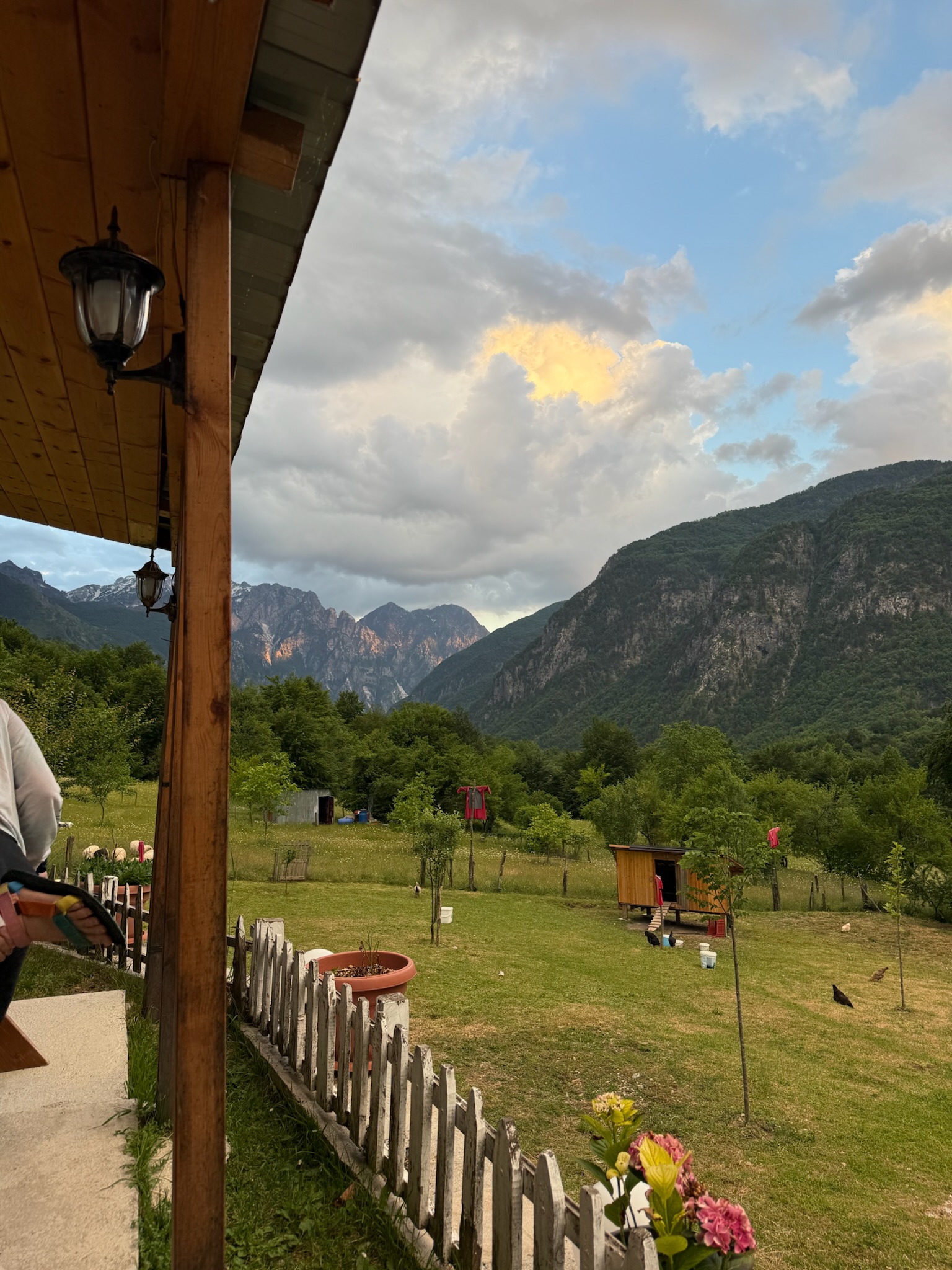
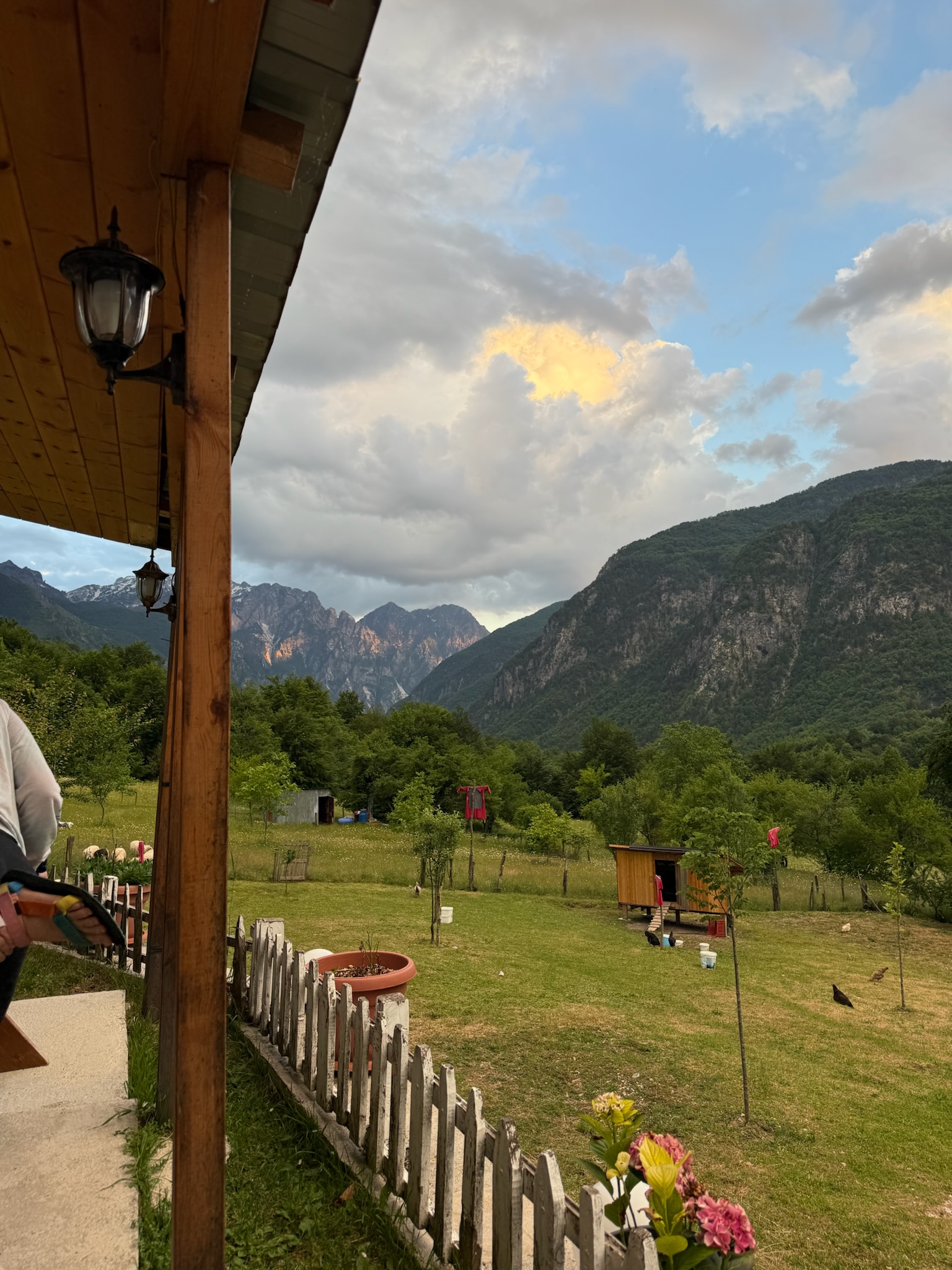
The guesthouse was built into the side of the mountain, all wood and stone, with a few picnic tables and an outdoor refrigerator full of Peja (Albanian beer.)
Hikers from the UK, Israel, France, Germany and the United States gathered outside, hanging socks to dry and soaking in the last hours of sunlight. Below us, green hills rolled into a valley, interrupted by dramatic gray-and-black mountains thick with trees.
Inside, an older couple was brewing a feast. We waited excitedly until we were called to a long wooden table and were served tavë kosi, byrek and fërgesë family style. By then, everyone knew everyone’s name, asking them to pass each of the dishes. The man who ran the guesthouse, born in Germany, sat and ate with us while the table filled with conversation.
Bellies full, we pattered upstairs to rooms lined with bunk beds, fell asleep and prepared to do it all again the next morning.
For one night, we had been folded into a place that would continue without us. We felt like travelers.
I first encountered the traveler-tourist distinction through the great Anthony Bourdain on Parts Unknown. He understood the traveler as someone who moved: “As far as you can, as much as you can. Across the ocean, or simply across the river. Walk in someone else’s shoes or at least eat their food.”
After a week on the Camino del Norte and 10 days hiking the Peaks of the Balkans through Albania, Montenegro and Kosovo, I had plenty of time to ponder the distinction. I remained in my own shoes—my trusty Salomons—but ate pintxos in Basque bars and homemade bread and cheese in Albanian guesthouses.
Passing through each town was a reminder of how inconsequential I was. I was movement. A sweaty body with a backpack. Fingers crossed, a better visitor. A less annoying fly.
Fingers crossed, a better visitor. A less annoying fly.
Because that is how I picture tourists sometimes: flies. A hot, humming mass descending on a place in search of something novel and authentic, landing on every surface until it is impossible to tell what the place looked like before the flies arrived.
Then the reasonable part of my brain arrives, unfortunately.
Ella, you are also a fly.
My family’s blood is not in this soil. Albania did not spend thousands of years forming its mountains so I could stand on top of one and feel spiritually superior to people on cruise ships. I am a visitor. I arrived on a plane. I own a smartphone. I took pictures.
Still, I cannot let go of the traveler-tourist distinction completely.
During both the Camino del Norte and the Peaks of the Balkans, I felt a down-to-earth kind of welcome that I had not experienced on more “touristy” trips. I was not treated only as a money bag, nor was I pretending to belong. I was simply a person on the move, briefly entering someone’s life and offering conversation, stories and a bit of money in exchange for a warm bed and food.
For centuries, pilgrims walked from their front doors toward the Cathedral of Santiago de Compostela. Imagine Santiago as the heart and the different Camino routes as veins. Some are thick and crowded. Some are smaller, blue and quiet beneath the skin. All of them move toward the same place.
My sister and I began at an airport, which is admittedly less biblical. But once we started walking, that fact became less relevant.
We walked through farmland, eucalyptus forests, fishing villages and stretches of coastline so open and empty that I became extremely grateful for the yellow Camino shells reassuring me that we had not wandered in the wrong direction. Most days, we passed fewer than a dozen other pilgrims.
The Camino took us through. At walking speed, the villages suddenly appeared. And it was a good reminder. Travel has a way of convincing you that everything you see is somehow being presented to you.
But the fishing village was not waiting for us to arrive. The farmers were not tending their fields to add visual interest to our pilgrimage. A grandmother hanging clothes from a balcony was not demonstrating the beautiful simplicity of European life. She was trying to dry her pants.
This feels obvious. It should be obvious.
I once heard a story about a famous photographer who sometimes forces himself to put down his camera. He disciplines himself to just watch the earth and its interactions without photographing it. Because he believes that sometimes the camera becomes the distraction. That scene was meant just for him, his memories, as the one who was there in the flesh to experience it.
I thought about this constantly while walking.
My twin and I took photos, yes, but we also just watched the lives of those in the Spanish countryside as they were happening, as they allowed us to pass through and glimpse them.
I think this is what people are trying to describe when they use the word authentic.
Authenticity is one of those words that travel media has beaten nearly to death. Authentic restaurant. Authentic neighborhood. Authentic cultural experience, available online for $79.99 per person, beverages not included.
But isn’t the whole point of authenticity that it cannot be arranged for your consumption?
Authenticity is simply a place existing for reasons other than you. And there is freedom in realizing none of it is for you.
Second piece of evidence: our first night at a farmhouse in Albania.
The owner, a farmer, was trying to ask us what we wanted to eat. We did not speak Albanian. He did not speak English. He pointed toward the kitchen. We nodded. He made eating gestures. We nodded harder. He raised his voice, apparently hoping the English language would reveal itself if he spoke Albanian loudly enough. We raised ours too, because we were operating under the same theory.
At the same time, the farm puppy kept escaping from its little doghouse. The farmer would point at the puppy, point at the house and tell us something we could not understand. We would nod solemnly, put the puppy back and then, within minutes, let it out again, giving into its mournful cries.
This happened several times.
Eventually, through an elaborate combination of pointing, miming, raised voices and what I believe was divine intervention, we understood one another. We got dinner. The puppy temporarily remained incarcerated. International relations were restored.
Welcome to the Peaks of the Balkans.
The trail loops through the Accursed Mountains, crossing old shepherd paths and national borders between Albania, Montenegro and Kosovo. Each day, we saw maybe 10 other hikers, often the same ones we had seen the day before.
Each night, we stayed in family homes and stone farmhouses adapted for hikers. A 13-year-old checked us into one with the authority of someone three times her age. Families sold cheese and raw milk halfway up mountains. Border collie puppies followed us down the trail before disappearing back into the valley.
Tourism supported these communities. Our money mattered. But they did not exist solely for us. There were cows to milk, gardens to tend, relatives to argue with and children to raise. We briefly entered those routines, ate at their tables and slept under their roofs. In the morning, we put on our backpacks and left.
It was a strange and limited intimacy. You can sleep in someone’s home, eat from their garden and still know almost nothing about them. You can feel deeply welcomed without belonging..
Perhaps that is what passing through is: accepting closeness without mistaking it for ownership.
Of course, there is a flipside in my entire argument.
The moment I write about a place whose appeal partly lies in how few visitors it receives, I invite more tourists to go there. The moment somewhere becomes known for being undiscovered, it has been discovered. You cannot publish “Ten Untouched Destinations” without touching them.
Every article, recommendation, geotag and hiking reel leaves a fingerprint. I am leaving one now.
But keeping a place secret is not necessarily an act of protection either. The families running these guesthouses deserve customers. Their communities should be allowed to benefit economically from the places they have built and maintained.
So now I have argued myself into a small, dark corner.
Tourism can damage places. Tourism can support them. Writing about a place can change it, but refusing to write about it does not preserve it in amber.
So I shall leave my goal the same as it was. To be a traveler. A fly who wants to witness without needing to possess. To eat what is offered. To pay what is asked. To keep my phone in my pocket sometimes. To accept that I will misunderstand most of what I see.
Then I want to keep moving.
To just keep passin’ through.
Want to read more about the two adventures?
→
 ella's inkwell
Leave a comment